
I went to the Mid-Atlantic Emergent Conference with Pete Rollins on Saturday. I have a lot of thoughts, both about the conference in general as well as about his talk in specific, but for now I'm posting this 3 minute video which sums up a lot of Rollins' style and message, which I love.
Showing posts with label emergent church. Show all posts
Showing posts with label emergent church. Show all posts
November 10, 2008
Peter Rollins

May 19, 2008
Tony Jones Asks Good Questions
I wasn't sure, originally, if I was interested in Tony Jones's book The New Christians when I first heard of it coming out. While wasting a few hours feed surfing and clicking through to other sites, I found an unedited video of Jones interviewing a guy who goes by the online name of "Pastorboy" -- an evangelical pastor who's been consistently vocal in his anti-emergent sentiment. I was so intrigued by the interview that I went out and bought the book that day (and really enjoyed it, too).
Now, on Jones's blog, he's posted a series of related webisodes, and the latest (#5) includes clips from the interview I saw. It's worth watching, but I've included one of my favorite segments below the video. Great questions to think about.
Pastorboy: The trouble that people from my worldview kinda really have with emergent is they don't understand it, they can't nail it down, they can't get it.... Where we have a problem is when there's kinda some squishy or untidy language that's being used. I think a lot of problem has to do with there's no real statement of faith.
Tony Jones: But the Bible doesn't have a statement of faith.
PB: The Bible is a statement of faith.
TJ: Okay, but why can't I just say then, that's my statement of faith? Why do I have to give you another one? Why isn't that one good enough?
PB: It is good enough. But there's parts of the statement of faith, like for example, who is Jesus?
TJ: Okay, I'd say, Jesus is who the Bible says Jesus is.
PB: Okay, but let's nail that down.
TJ: Why? That's my question! Why?
May 5, 2008
New Churches As Social Networks
Minnesota pastor, author, and blogger Doug Pagitt recently said,
I think that Christianity is fundamentally a people movement that we should understand in social networking theory, not a belief system that we distribute through institutional applications and franchising models.
It's an interesting idea--that Christianity should be understood as connected people, not as distributed beliefs. That who we are as a church is based around who we are as a group of people and how we connect to one another, and not focused primarily on the common beliefs we hold.
But wait, I hear the concerned masses cry out: people have to agree on a set of beliefs to be a Christian church. Make the set as small as you like, they demand, but you can't entirely remove "belief system" from what it means to understand Christianity. I think that's true.
But no social network can exist without some degree of commonality among its members. The Pomeranian Lovers' Facebook Group doesn't require proof that its members love Pomeranians. But what Pomeranian hater would want to join such a group? And what harm would it do to the goals, mission, thrust, and objectives of the group if he or she did?
These kind of questions are really about belief management styles, or so I'll call them. Social networks have a passive belief gate, letting in anyone who wishes to join, but trusting that a) people who don't share the beliefs and vision of the group will be unmotivated to join and b) that if people who don't share those beliefs do join, no harm is done. Group members will understand, for instance, that a Pomeranian Lovers' group will have events geared toward their love of Pomeranians, etc.
In contrast, traditional evangelical churches usually use an active/aggressive belief gate, allowing visiting members to observe the service for a time with no belief obligation before urging them to make a commitment (become a member), involving a signed agreement to the church's beliefs. And liberal churches often use no belief gate at all, unless the beliefs are more social justice oriented.
For years the churches on the right have aggressively pursued this sort of orthodoxy in their congregations, while churches on the left have adopted inclusivity-at-any-cost, to the point of pretending there are no beliefs that hold their group together.
What many of us are beginning to realize is that the people who don't want to be shoved into a box of pre-packaged beliefs are equally disinterested in joining a beliefless club.
Even senseless social networks (like Facebook's "10,000,000 People Challenge" whose sole purpose is to get ten million people to join) are drawing from people's desire to be part of something bigger than themselves while working toward a common goal, no matter how trivial.
The challenge for the new, dare I say emerging church is to understand how to become a network that clearly displays its common beliefs without making them a requirement for membership. There are folks who are doing this, and doing it well from what I can tell, and my inbred inclination is to contact those people and ask them for a bottle of their strategy to use in my own franchise of their successful church model.
But that's exactly how it doesn't work. This kind of network springs up from its surrounding environment. The more you talk to other people, the more inspired you become, in theory, to see how their general ideas (or sometimes their opposites) will play out in your own neighborhood context.
That's why the franchise model is less effective for this kind of understanding of church. The aggressive belief gate is meant to be portable, allowing churches to send out church plant franchises without too much worry that they'll misrepresent the beliefs of the larger church. But when you slide a shiny membership application in front of many new church-goers, they look at many of the questions and scratch their heads.
"Well, I'm sure I don't agree on everything about God with everyone who goes here. But I'm here because I want to continue to explore all those things with you all. Is that enough?"
Part of being a people's church is knowing how we'll answer that question.
March 19, 2008
Why So Angry?
Russell Moore, while filling in for Albert Mohler on the Albert Mohler radio program several months ago, interviewed Tony Jones of Emergent Village.
Listen to the interview.
Read Jones's (.pdf) paper that Moore focuses on during the interview.
After the interview, Moore had some commentary. The following quote caught my attention.
Russell Moore: I think the reason that the emerging church conversation is gaining a foothold is because many in the emerging church are pointing to some people in our churches and they are absolutely right. Too many of our churches are not counter-cultural. Too many of our churches do not have real authenticity. Too many of our churches do not have real community. Too many of our churches are awash in consumerism and boring, American middle-class life.
I think the problem is that you have some people that are coming in willing to talk about these things and they're called "Emerging" because they wear black turtlenecks or sit on a stool, but they're faithful Christians. But you have others, like [Tony Jones], kind of growing out of youth ministry curriculum peddlers and [unclear], taking consumerism to the next level.... That's not new. The inerrancy debate that Tony Jones says is new? That's been going on since the Garden of Eden, and it still is. Truth is of God. Truth is about Jesus.
I think it's interesting and somewhat confusing that he starts off by generally agreeing with a lot of what Emergent Village and those in the greater emerging church conversation have been saying*, and then finishes by pouring a load of disdain over most of them. And then he finishes with two seemingly irrelevant rallying platitudes that no one would disagree with. Where does this strong urge to criticize and condemn come from?
Also, Moore repeatedly used a quote to defend the idea of absolute truth that was something along the lines of "my Word is forever settled in the heavens." I hadn't heard it before, and I can't find it in the Bible anywhere. I see a hymn that has it. Is this Scripture or not?
What a confusing and exciting and weird and fun and strange time to be a Christian.
*With the one glaring exception of what I bolded in Moore's comments. Can someone explain to me why "counter-cultural" is good?
March 18, 2008
A Conversation About Inclusivity
Everyone talks about how we should be more inclusive, implying that we should accept everything from everyone, no matter what. What are the consequences of opening that door?
Inclusivity is the new tolerance. Remember when tolerance was the big buzz for churchy arguments? Slippery liberals cried, hugged, sang Kumbayah, and begged us all to be more tolerant while stern-nosed, crotchety conservatives rolled around in their big piles of money and grumbled about loving the sinner and hating the sin. It was the argument du jour for quite a few years. For whatever reason, we don't hear too much about tolerance anymore, but we've replaced it with a new argumentative ideal called inclusivity!
Inclusivity, despite being a made up word that smacks of snooty elitism, is a Pretty Good Thing. As the church we want to do everything we can to make people feel welcome and to give them the good news that they're loved. We all know that Jesus ate with tax collectors and sinners, he let the children come to him, he didn't send the hooker away when she poured oil over his feet at a dinner party, and he even sat and talked with one of the Pharisees he had such harsh words for at other times. In fact, there are exactly zero stories in the Gospels that describe Jesus turning anyone away (with the exception of when he would move on to another town and had to send the crowds home, etc.). These are hard attitudes to adopt as a church community, when so much of our language is built on who is in and who is out.
In fact, you could make an argument that Burning Man, the annual art-fest held in the Nevada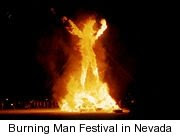 desert, embraces a more Jesus-like attitude than many of our church policies often do. The event, which has gained a lot of popularity and publicity over the past twenty years, has since developed the 10 Principles of Burning Man, which include radical inclusion, gifting, communal effort, civic responsibility, and participation. While the event is by no means a Christian one, it is quite a display of the kind of radical inclusion that many, especially in the Emerging Church, are so keen to apply to our church implementations. "Let's be radically inclusive!" could be a rallying cry or pep motto for a lot of postmodern cheerleaders.
But we have to be careful as we get caught up in great-sounding ideals that we don't set up unassailable positions. What I mean is, for example, the abortion debate is often framed as "Are you okay with murder?" or "Pro-choice is pro-abortion" or even "Do you like babies?" Simple platitude questions like those ignore the complexity on both sides and make any kind of healthy discussion impossible. We really need to be careful that we don't do the same for inclusivity by framing the issue as "Do you love people?" when it's much more complex than that kind of softball question suggests.
I'll give three examples of what I think are some of the dangers of inclusivity. The first two involve worship, as I spend a lot of my church time as a worship leader. Recently I've even taken on the role of organizing worship from week to week, which makes me the person to talk to when you want to be involved with the worship team or whatever you call it. And that's where it gets sticky, because a pure doctrine of inclusivity suggests that we allow anyone and everyone to be involved. But what if someone sings really badly? Or what if they don't play their instrument very well, and show little sign of caring to improve? Make a joyful noise to the Lord, people will say, until that noise distracts them from their own worship, and then it's "Please make your joyful noise in another room, thank you."
So inclusivity can lead to distracting worship, unpredictable results, and possibly awkward or offensive situations, but it can also open the door to poor quality. Spencer Burke's website, THEOOZE.com, is an incredibly collaborative project, with a blog that has a list of 33 regular contributors. In addition to the blog there's a section for Articles of various topics and kinds. I have absolutely no idea what the screening process is for these article submissions, if any, but a close look at the most recent article (entitled "Five Second Theology Without Meaning: Living the Church Organic, Part 2" by John O'Keefe) shows why standards are sometimes helpful. I've included a few of the sentences from the article below.
I don't mean to pick on Mr. O'Keefe too much. I don't know anything about him or his story, and I encourage you to go and read his article for yourself. But there's a debate to be had about quality and how much it matters as we try to hammer out the concept of inclusivity in each of our churches. Some people will encourage participation at any cost while others will hope that the way we represent God and theology will be held to some standards of excellence.
So inclusivity is good, but it can have unwanted or unintended consequences. How can we include people and still have standards? Is true inclusivity the absence of standards and the acceptance of everyone's offerings, no matter what? If you read this blog at all you won't be surprised that I have no answers, but I hope the conversation moves beyond "Do you love people?" and on to some of the other questions that some of us have. I've raised a few of those questions here, and I hope some of you raise even more in the comments. (Please no stupid questions, though. Thanks.)
grumbled about loving the sinner and hating the sin. It was the argument du jour for quite a few years. For whatever reason, we don't hear too much about tolerance anymore, but we've replaced it with a new argumentative ideal called inclusivity!Inclusivity, despite being a made up word that smacks of snooty elitism, is a Pretty Good Thing. As the church we want to do everything we can to make people feel welcome and to give them the good news that they're loved. We all know that Jesus ate with tax collectors and sinners, he let the children come to him, he didn't send the hooker away when she poured oil over his feet at a dinner party, and he even sat and talked with one of the Pharisees he had such harsh words for at other times. In fact, there are exactly zero stories in the Gospels that describe Jesus turning anyone away (with the exception of when he would move on to another town and had to send the crowds home, etc.). These are hard attitudes to adopt as a church community, when so much of our language is built on who is in and who is out.
In fact, you could make an argument that Burning Man, the annual art-fest held in the Nevada
desert, embraces a more Jesus-like attitude than many of our church policies often do. The event, which has gained a lot of popularity and publicity over the past twenty years, has since developed the 10 Principles of Burning Man, which include radical inclusion, gifting, communal effort, civic responsibility, and participation. While the event is by no means a Christian one, it is quite a display of the kind of radical inclusion that many, especially in the Emerging Church, are so keen to apply to our church implementations. "Let's be radically inclusive!" could be a rallying cry or pep motto for a lot of postmodern cheerleaders.But we have to be careful as we get caught up in great-sounding ideals that we don't set up unassailable positions. What I mean is, for example, the abortion debate is often framed as "Are you okay with murder?" or "Pro-choice is pro-abortion" or even "Do you like babies?" Simple platitude questions like those ignore the complexity on both sides and make any kind of healthy discussion impossible. We really need to be careful that we don't do the same for inclusivity by framing the issue as "Do you love people?" when it's much more complex than that kind of softball question suggests.
I'll give three examples of what I think are some of the dangers of inclusivity. The first two involve worship, as I spend a lot of my church time as a worship leader. Recently I've even taken on the role of organizing worship from week to week, which makes me the person to talk to when you want to be involved with the worship team or whatever you call it. And that's where it gets sticky, because a pure doctrine of inclusivity suggests that we allow anyone and everyone to be involved. But what if someone sings really badly? Or what if they don't play their instrument very well, and show little sign of caring to improve? Make a joyful noise to the Lord, people will say, until that noise distracts them from their own worship, and then it's "Please make your joyful noise in another room, thank you."
Inclusivity and worship can get even stickier, too. At Solomon's Porch in Minnesota, they encourage everyone to be involved not only in the singing and instrument-playing but also with the writing of their all-original worship songs. The concept is amazing, and one I want to try to incorporate, because it gives the community a chance to express itself in beautiful wa ys. But again, straight inclusivity demands that we allow everyone's song to be played and every lyric to be sung. This could be one of the most terrifying ideas I've ever heard of -- open that door so wide and who knows what will come in? Am I prepared to deal with the consequences of whatever it is?
ys. But again, straight inclusivity demands that we allow everyone's song to be played and every lyric to be sung. This could be one of the most terrifying ideas I've ever heard of -- open that door so wide and who knows what will come in? Am I prepared to deal with the consequences of whatever it is?So inclusivity can lead to distracting worship, unpredictable results, and possibly awkward or offensive situations, but it can also open the door to poor quality. Spencer Burke's website, THEOOZE.com, is an incredibly collaborative project, with a blog that has a list of 33 regular contributors. In addition to the blog there's a section for Articles of various topics and kinds. I have absolutely no idea what the screening process is for these article submissions, if any, but a close look at the most recent article (entitled "Five Second Theology Without Meaning: Living the Church Organic, Part 2" by John O'Keefe) shows why standards are sometimes helpful. I've included a few of the sentences from the article below.
Ever had your world explode around in with such force you are left deaf from the noise and numb to the results for days?
Have you ever been so moved by hurt, pain and loses that all you want to do is go into a corner, curl up in a ball and just stay forever and let the world move along without you?
I have, several times in my life, had those feeling.
I don't mean to pick on Mr. O'Keefe too much. I don't know anything about him or his story, and I encourage you to go and read his article for yourself. But there's a debate to be had about quality and how much it matters as we try to hammer out the concept of inclusivity in each of our churches. Some people will encourage participation at any cost while others will hope that the way we represent God and theology will be held to some standards of excellence.
So inclusivity is good, but it can have unwanted or unintended consequences. How can we include people and still have standards? Is true inclusivity the absence of standards and the acceptance of everyone's offerings, no matter what? If you read this blog at all you won't be surprised that I have no answers, but I hope the conversation moves beyond "Do you love people?" and on to some of the other questions that some of us have. I've raised a few of those questions here, and I hope some of you raise even more in the comments. (Please no stupid questions, though. Thanks.)
March 10, 2008
What About Seminary?
Here's me. I grew up in a 'Northern' Baptist congregation in Erie, PA. By the time I was in 6th grade I was getting involved in the youth group leadership. By my senior year I led the youth group as student leader (under guided yet trusting supervision from an amazing youth pastor) as well as the "Bible Club" at my large high school. You could say I was involved.
I left Erie and went to Penn State University to major in Religious Studies at a secular school. I can't explain why it was so important for me to do this at a time when everything I know about myself should have made me desire a Christian education, but there I was, taking courses on New Testament criticism taught by aggravated atheists. I spent four and a half years there, completing both a Religious Studies B.A. and a Sociology B.A. (I couldn't resist Roger Finke's Sociology of Religion course, and got hooked on the subject). And though a lot of things shifted and changed for me over that time, I never got any less passionate about pursuing the truth.
After graduating, I continued going to church for the sake of my desire to be a part of community worship. But the disconnect I felt in my relationships with Christians (old and new) and in the sermons I heard preached most Sunday mornings eventually wore me out, and my wife and I left. We took a year away from church, retreats, worship nights, seminars, sermons, pastors, baptisms, etc. But not from thinking.
A year later brought me to last October, when we got involved with a little church plant in Baltimore called The Light. We couldn't stay away from church forever, and the draw to be involved in Christ-centered community again finally got to be more powerful than the fear and dread that surrounded it. As we've gotten more involved, the passions I have for these issues have gotten more and more inflamed. I've been reading as many books as I can get my hands on, listening to sermons online, writing, talking to people, reading blogs and articles, and basically eating and breathing these things for the past 6 months.
Which brings me to a question I've come back to several times over this last half year. What do I want to do? I work in a research office, managing grants and contracts and budgets. I went to a meeting this morning for my department and heard them all talk about budget discrepancies, cost sharing, and NIH deadlines. I might as well have driven a spike through my eye socket and out the back of my skull. I know for certain I don't want to be here all my life, but they pay me twice a month and it's enough to live on. And that's pretty nice.
This is usually the point of this conversation when a lot of people say, "Well you have to do what makes you happy and alive -- so if x makes you happy and alive, you should drop everything and do x!" What makes me happy and alive is reading, writing, teaching, talking, and thinking about God, Christ, community, church, and people. Which provokes that same person to say, "Sounds like you want to be a pastor!" (This person uses a lot of exclamation points.) But something inside my stomach lurches 100 feet in the air at the thought of becoming a pastor. All I know is that I want to do those things as much as possible.
So what about seminary (see post title)? Should I go? Should I enroll in a part time program that I can go to while I work? Or better yet, do I need to go in order to do the things I want to do? Would it be really good for me to go, or would it end up being a waste? Will it allow me more freedom to do what I love or apply restrictions on me in a way that makes me crazy? Is it worth the time it will take and the money it would cost? Would it be better to get a Master's in something I'm interested in and just go from there? What if I'm scared to ever accept money from a church because I don't know how I feel about that, would that be the kind of feeling that should tip someone off that seminary isn't right for them?
Here's the biggest, "mainest" question: Why do people go to seminary for an M.Div.? Is it only when they know they want to become a pastor or other full-time minister?
Lots of questions. Comments, answers, cheers, jeers, and other responses are welcome.
November 30, 2007
A Semi-Millennial Cycle
Approx 1 A.D. - Jesus is born.
Approx 500 A.D. - The Fall of the Roman Empire.
Approx 1000 A.D. - The Great Schism, separating Eastern Orthodoxy from the Pope and his Roman Catholic Church.
Approx 1500 A.D. - The Great Reformation, separating Roman Catholicism from Luther and his Protestant movement.
Approx 2000 A.D. - ?
...
The time is ripe for something to happen. What will it look like? (Thanks to the EV Blog for tipping me off to this article.)
November 2, 2007
God Likes Sir Arthur Conan Doyle
This post got a little out of hand and is now pretty long. So here's a short summary: Some people in the church disagree with each other. The more defensive you are about it, the more insecure and fearful you usually are about your own positions. God is a mystery, and that's okay. Can we learn more about the mystery of God from our disagreements instead of developing our own forms of modern-day excommunication?
Brian McLaren is scaring the hell out of people. In the process, he's revealing an unfortunate attitude, a sort of defense system designed to guard against the horrifying fear that we could be wrong about a lot of important things. To be honest, I have trouble caring about anything that McLaren says anymore (I've been trying to plod through The Secret Message of Jesus for the last year and a half without much success), but this interesting effect he's had on the Christian community recently caught my attention.
For instance, the folks at Discerning Reader have posted a review of McLaren's new book called Everything Must Change. The reviewer appears to have a somewhat negative history with Mr. McLaren, so a negative review is unsurprising. It's not the disagreement that catches my eye, it's the defensive attitude that bubbles up around the discussion of his name.
For example, in his book McLaren apparently writes a version of Mary's Magnificat (the prayer she sings in Luke 1:46-55, giving thanks for her conception). His version, however, is supposed to be from a more Protestant perspective. I read the portion that was quoted in the review (you can too if you click the link to the review above) and I can understand how it could easily be seen as disrespectful, distasteful, or insensitive. But the Discerning Reader (DR) response goes a little further than that.
Time would fail me to even begin to address all of the doctrines he mocks and belittles even in this one paragraph. Suffice it to say that no doctrine is safe, with those closest to the heart of the gospel the ones that disgust McLaren the most. Just this one paragraph ought to shock and disgust any Christian.
One author's representation of the Protestant perspective--a perspective he's been a part of for many years--should cause all Christians to feel shock and disgust because he dared to say nasty things about us, sort of? Can you see the defensive reactivity that explodes from the page and how it seems so disproportionately intense?
Later in the review, DR continues.
With McLaren’s willingness to play fast and loose with Scripture, interpreting it as he seems fit with utter disregard for the stream of historic orthodox theology and the context of Scripture, how am I to trust his presentation of economics? If he is willing to adapt Scripture to fit his agenda and to do so at the expense of its most clear and obvious meaning, what confidence can I have that he has not done the same in other areas?
Now, maybe after reading the book, I'd sympathize more with the intensity of this response. But the content is telling, too. We're too quick to accuse others of "playing fast and loose with Scripture," forgetting that none of us has access to the One True Meaning of the Infallible Word™. We're all willing (and often required) to adapt Scripture to fit our agenda. There is rarely a clear and obvious meaning, and those that use that kind of language to describe Scripture often have the most relentless agendas of all.
We devote ourselves to the intense study of Scripture precisely because of the deep, rich meaning that lies within the text. We are all subject to interpretation, whether it's our own or the one of someone we trust (an author, a great leader, a Church tradition).
God and his word are a great and wonderful mystery. Passages like Romans 11:25, Ephesians 1:9, Ephesians 5:32, Colossians 4:3, and 1 Timothy 3:16 all speak of the great mystery of God that has been revealed to us. I used to think that it meant that what was once a mystery is now unveiled, and the mystery is gone. But it says that the mystery itself is revealed, not the answer. What Adam and Eve lost in the garden when they reached for the fruit of the knowledge of good and evil, Christ brought back in the form of the mystery of God.

Unfortunately, we're really uncomfortable with mystery. And consequently, most American churches are uncomfortable with questions, and especially with the answer of "I don't know". How can God predestine all things while still allowing us choice? If your answer is, "It's a mystery of God, my child," you should expect a punch in the face.
So when a group of Christians starts asking lots of questions and not giving many clear answers, the natural reaction of many in the Church is to give them a symbolic punch in the face. A friend of mine who is in seminary near Philadelphia, PA told me that his seminary teachers have instructed him to avoid all of Brian McLaren's writings. Avoid reading what someone has to say about God, because you might become confused and think of God as a mystery, instead of clearly understanding their version of the truth alone. What kind of education, what kind of Godly leadership would discourage the pursuit of knowledge and truth? Even if they disagree with every word he says, what's to be gained by advising your students to avoid them (except having the exact opposite effect, I'd guess)?
I know of several pastors who preach out against the entire "Emerging Church" movement, and any writers that they believe are involved (whether the writer actually associates with it or not). Again, besides the fact that this is the fastest way to get people to read books by these people and become interested in this movement, what is it that you're so worried about? If it's not true, and they trust you as their pastor/leader/counselor/etc, they'll start a conversation with you about it. Conversations about God and his works are good, right?
Don't freak out so much, people. Mystery is a good thing. And people who chase after the mystery of God are continually blessed by it. So by all means, please disagree with Brian McLaren, but it would help us who disagree with you if you left the shock and disgust behind.
October 25, 2007
So What Is This "Emergent Church"?
I mean, I'm drawn to it. The idea of new, "cutting-edge" church philosophy that incorporates a lot of freedoms that I love is obviously going to make me get a little excited. But the more I read and explore, the more hesitant I become, and I'm trying to understand why.
If you haven't yet heard of the "emerging church", Wikipedia is your friend. The opening line of the entry describes it as "a controversial 21st-century Protestant Christian movement whose participants seek and to engage postmodern people..." (Yes that's right, they seek and to engage. Nothing lends credibility like bad grammar.) Despite its obvious flaws, I like Wikipedia because I think it gives a pretty good description of how something is actually seen or experienced by a majority of people. And this mysterious "majority of people" seem to think that the emerging church is "controversial".
If we are going to be completely honest with each other, I probably have to mention to you that this perceived controversy is at least half of the reason that the whole Emergent/Emerging movement (again, see Wikipedia for the ridiculously unclear difference) is gaining so much publicity. It's sort of like the kid who yelled "fight" in the halls of your high school -- some people were rolling their eyes and some people were cheering them on but everybody ran to watch. But this fight isn't between a jock and a punk in the halls of a high school, and there's probably a little more at stake. Regardless of who's right or wrong, are the unsuperficial parts of this fight good or bad for Christianity or humanity as a whole?
Here's why I think it's a Good Thing:

- Freedom to explore and ask questions. The church is too good at squashing questions and questioners, as if its goal is to raise up an army of unthinking servants who recite their memorized lines in unison. Abortion is murder, protect the family, sexual sin is the worst kind of sin, Max Lucado is a great author, Josh McDowell used to be an athiest but look what happened when he tried to disprove the Bible, love the sinner hate the sin, etc. I grew up in the Church and I know this is not the real goal of most church people. So I think it's a Good Thing to stop making it seem like it is.
- Epistemological humility and the freedom to not know. Epistemological humility is just a fancy way of saying "uhh... we don't actually know everything." Growing up, I remember getting in numerous theological debates (I had a very boring childhood, you might say). It never once occurred to me that the appropriate answer to any number of theological questions is "I don't know." To answer that way would have been worse than admitting defeat, bringing shame upon my children and their children for generations to come. And yet, there are so many things we don't know or understand. I think it's great to admit that.
- Openness to new understandings. The concepts of infallibility and inerrancy have probably gained too much weight as Foundational Pillars of the entire Christian Faith, especially when the concepts seem to be misunderstood so often. What we have is our own interpretations and the interpretations of those we trust. When we ask questions and admit that we don't know all the answers, we begin to realize that some of our theological understandings may be built on misguided logic or unfounded assumptions. I think Jesus taught in parables as a way to get his audiences to engage with what he taught them, to talk it out and grapple with it on a personal level and with each other. When we seal off all theological interpretations as final, binding, and untouchable, I think we do damage to the spirit in which they were presented by Jesus himself.
- Emphasis on love and mercy. Jesus said that the greatest commandment is love. I like when groups begin to focus on how to better love each other, not just within the Church but all people everywhere. Sometimes it seems as though so many years were spent on preaching justice, wrath, and how to avoid sin that we may have missed out on some of the stories of redemption and healing that God meant for us to emphasize to the world. The harshest of Jesus' condemnations were saved for those who thought themselves righteous members of the church, while his softest and most loving conversations were with the lowest of sinners. To follow his example is, I think, to preach his message of love and grace and leave judgment to God.
- Elitism. Trading one kind for another is the worst kind of trick. I would hate to become so concerned with being a part of this "emergent" group that I entirely missed the point. Already people have begun to parody members of the movement as looking a certain way, using certain buzz words, and espousing certain trademark idiosyncrasies. And it's easy to begin associating all of this branding with an intellectual snobbery that says, "We're smarter and cooler and trendier, so why don't those idiots understand how awesome we are and join us?"
- Useless controversy. I think parts of the "fight" are good and necessary, but I think a lot of others are just for the sake of drama and publicity. Nothing gets more hits for your blog than saying something with a little bite to it, right? Conversations that are filled with grace will go a lot further toward making this a meaningful and productive discussion, but they aren't as exciting. People like it when their blood boils a little bit.
- It's a phase/fad/temporary excitement. It feels more exciting now to say, "There's a whole new church rising up and it's going to be completely different and it's going to change the way we think about everything, and it's emerging with a new postmodern worldview as we leave the modern era behind!" But really, we're going to move along just as slowly as we always have, and ten or twenty years from now our kids are going to say, "What's this 'emergent church' thing that you guys used to talk about?" or, "Haha remember when people thought the 'emergent church' was the big thing? That was so lame. They didn't realize that it's actually the Post-Re-Emergent Post-Community Gathering Conversation that is the real new movement, and this one's going to last..."
- Reactionary decisions. So much of the movement is made up of people who have had poor experiences with previous Evangelical churches. This is bad for two reasons -- people who are bitter about past experiences tend to use harsh, negative language when referring back to those groups, and decisions based on this kind of reactionary movement tend to be less thought out since they are partly based on anger.
Perhaps the best church to emerge from these conversations will emerge within the churches that we already belong to, as we try to work to redeem the broken relationships we have within them. Or maybe the freedom of new ideas will never catch on within the established churches and the movement will be forced to find new homes as it has already begun to do. It's probably too early to tell. But no matter what happens, I think any of us who sympathize with the good sides of this movement would do well to follow Mark Van Steenwyk’s “7 Loving Challenges for Emergent,” which are summarized here on the Emergent Village blog. If this topic interests you, that blog is a good place to watch.
Subscribe to:
Posts (Atom)


