
If you know me, you probably know that I love sociology and I love religion, especially everything about that sad hopeful mess called church. I ran across a summary paper by Josh Packard the other day, and found his research to be really interesting.
It's worth a read.
Showing posts with label emerging church. Show all posts
Showing posts with label emerging church. Show all posts
April 9, 2008
Sociology of Church

April 1, 2008
The Ship of Fools
Allow me to plug one of my all-time favorite sites, The Ship of Fools, and tell you that today they are 10 years old. I've been there for only 3 of the 10, but a few features are definitely worth checking out (especially in their brand new layout and design unveiled today).
It's a magazine for Christian Unrest, so they are experts at poking fun of their own. The front page is full of a lot of wonderful foolishness, as they call it, including Gadgets for God, The Fruitcake Zone, etc. More on this later.
The discussion board forums, known as the Community, are outstanding. Kester Brewin mentioned them in his book, Signs of Emergence, and gave them a less than stellar review. I couldn't disagree more. Broken into several sub-boards by topic and tone (Purgatory being my favorite, where I've moderated for the past 2 years), they welcome all types of conversations from all kinds of perspectives. If you are up for robust debate about religious topics (or light-hearted debate about almost anything), check these out.
[/plug]

March 19, 2008
Why So Angry?
Russell Moore, while filling in for Albert Mohler on the Albert Mohler radio program several months ago, interviewed Tony Jones of Emergent Village.
Listen to the interview.
Read Jones's (.pdf) paper that Moore focuses on during the interview.
After the interview, Moore had some commentary. The following quote caught my attention.
Russell Moore: I think the reason that the emerging church conversation is gaining a foothold is because many in the emerging church are pointing to some people in our churches and they are absolutely right. Too many of our churches are not counter-cultural. Too many of our churches do not have real authenticity. Too many of our churches do not have real community. Too many of our churches are awash in consumerism and boring, American middle-class life.
I think the problem is that you have some people that are coming in willing to talk about these things and they're called "Emerging" because they wear black turtlenecks or sit on a stool, but they're faithful Christians. But you have others, like [Tony Jones], kind of growing out of youth ministry curriculum peddlers and [unclear], taking consumerism to the next level.... That's not new. The inerrancy debate that Tony Jones says is new? That's been going on since the Garden of Eden, and it still is. Truth is of God. Truth is about Jesus.
I think it's interesting and somewhat confusing that he starts off by generally agreeing with a lot of what Emergent Village and those in the greater emerging church conversation have been saying*, and then finishes by pouring a load of disdain over most of them. And then he finishes with two seemingly irrelevant rallying platitudes that no one would disagree with. Where does this strong urge to criticize and condemn come from?
Also, Moore repeatedly used a quote to defend the idea of absolute truth that was something along the lines of "my Word is forever settled in the heavens." I hadn't heard it before, and I can't find it in the Bible anywhere. I see a hymn that has it. Is this Scripture or not?
What a confusing and exciting and weird and fun and strange time to be a Christian.
*With the one glaring exception of what I bolded in Moore's comments. Can someone explain to me why "counter-cultural" is good?
March 18, 2008
A Conversation About Inclusivity
Everyone talks about how we should be more inclusive, implying that we should accept everything from everyone, no matter what. What are the consequences of opening that door?
Inclusivity is the new tolerance. Remember when tolerance was the big buzz for churchy arguments? Slippery liberals cried, hugged, sang Kumbayah, and begged us all to be more tolerant while stern-nosed, crotchety conservatives rolled around in their big piles of money and grumbled about loving the sinner and hating the sin. It was the argument du jour for quite a few years. For whatever reason, we don't hear too much about tolerance anymore, but we've replaced it with a new argumentative ideal called inclusivity!
Inclusivity, despite being a made up word that smacks of snooty elitism, is a Pretty Good Thing. As the church we want to do everything we can to make people feel welcome and to give them the good news that they're loved. We all know that Jesus ate with tax collectors and sinners, he let the children come to him, he didn't send the hooker away when she poured oil over his feet at a dinner party, and he even sat and talked with one of the Pharisees he had such harsh words for at other times. In fact, there are exactly zero stories in the Gospels that describe Jesus turning anyone away (with the exception of when he would move on to another town and had to send the crowds home, etc.). These are hard attitudes to adopt as a church community, when so much of our language is built on who is in and who is out.
In fact, you could make an argument that Burning Man, the annual art-fest held in the Nevada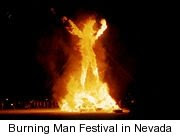 desert, embraces a more Jesus-like attitude than many of our church policies often do. The event, which has gained a lot of popularity and publicity over the past twenty years, has since developed the 10 Principles of Burning Man, which include radical inclusion, gifting, communal effort, civic responsibility, and participation. While the event is by no means a Christian one, it is quite a display of the kind of radical inclusion that many, especially in the Emerging Church, are so keen to apply to our church implementations. "Let's be radically inclusive!" could be a rallying cry or pep motto for a lot of postmodern cheerleaders.
But we have to be careful as we get caught up in great-sounding ideals that we don't set up unassailable positions. What I mean is, for example, the abortion debate is often framed as "Are you okay with murder?" or "Pro-choice is pro-abortion" or even "Do you like babies?" Simple platitude questions like those ignore the complexity on both sides and make any kind of healthy discussion impossible. We really need to be careful that we don't do the same for inclusivity by framing the issue as "Do you love people?" when it's much more complex than that kind of softball question suggests.
I'll give three examples of what I think are some of the dangers of inclusivity. The first two involve worship, as I spend a lot of my church time as a worship leader. Recently I've even taken on the role of organizing worship from week to week, which makes me the person to talk to when you want to be involved with the worship team or whatever you call it. And that's where it gets sticky, because a pure doctrine of inclusivity suggests that we allow anyone and everyone to be involved. But what if someone sings really badly? Or what if they don't play their instrument very well, and show little sign of caring to improve? Make a joyful noise to the Lord, people will say, until that noise distracts them from their own worship, and then it's "Please make your joyful noise in another room, thank you."
So inclusivity can lead to distracting worship, unpredictable results, and possibly awkward or offensive situations, but it can also open the door to poor quality. Spencer Burke's website, THEOOZE.com, is an incredibly collaborative project, with a blog that has a list of 33 regular contributors. In addition to the blog there's a section for Articles of various topics and kinds. I have absolutely no idea what the screening process is for these article submissions, if any, but a close look at the most recent article (entitled "Five Second Theology Without Meaning: Living the Church Organic, Part 2" by John O'Keefe) shows why standards are sometimes helpful. I've included a few of the sentences from the article below.
I don't mean to pick on Mr. O'Keefe too much. I don't know anything about him or his story, and I encourage you to go and read his article for yourself. But there's a debate to be had about quality and how much it matters as we try to hammer out the concept of inclusivity in each of our churches. Some people will encourage participation at any cost while others will hope that the way we represent God and theology will be held to some standards of excellence.
So inclusivity is good, but it can have unwanted or unintended consequences. How can we include people and still have standards? Is true inclusivity the absence of standards and the acceptance of everyone's offerings, no matter what? If you read this blog at all you won't be surprised that I have no answers, but I hope the conversation moves beyond "Do you love people?" and on to some of the other questions that some of us have. I've raised a few of those questions here, and I hope some of you raise even more in the comments. (Please no stupid questions, though. Thanks.)
grumbled about loving the sinner and hating the sin. It was the argument du jour for quite a few years. For whatever reason, we don't hear too much about tolerance anymore, but we've replaced it with a new argumentative ideal called inclusivity!Inclusivity, despite being a made up word that smacks of snooty elitism, is a Pretty Good Thing. As the church we want to do everything we can to make people feel welcome and to give them the good news that they're loved. We all know that Jesus ate with tax collectors and sinners, he let the children come to him, he didn't send the hooker away when she poured oil over his feet at a dinner party, and he even sat and talked with one of the Pharisees he had such harsh words for at other times. In fact, there are exactly zero stories in the Gospels that describe Jesus turning anyone away (with the exception of when he would move on to another town and had to send the crowds home, etc.). These are hard attitudes to adopt as a church community, when so much of our language is built on who is in and who is out.
In fact, you could make an argument that Burning Man, the annual art-fest held in the Nevada
desert, embraces a more Jesus-like attitude than many of our church policies often do. The event, which has gained a lot of popularity and publicity over the past twenty years, has since developed the 10 Principles of Burning Man, which include radical inclusion, gifting, communal effort, civic responsibility, and participation. While the event is by no means a Christian one, it is quite a display of the kind of radical inclusion that many, especially in the Emerging Church, are so keen to apply to our church implementations. "Let's be radically inclusive!" could be a rallying cry or pep motto for a lot of postmodern cheerleaders.But we have to be careful as we get caught up in great-sounding ideals that we don't set up unassailable positions. What I mean is, for example, the abortion debate is often framed as "Are you okay with murder?" or "Pro-choice is pro-abortion" or even "Do you like babies?" Simple platitude questions like those ignore the complexity on both sides and make any kind of healthy discussion impossible. We really need to be careful that we don't do the same for inclusivity by framing the issue as "Do you love people?" when it's much more complex than that kind of softball question suggests.
I'll give three examples of what I think are some of the dangers of inclusivity. The first two involve worship, as I spend a lot of my church time as a worship leader. Recently I've even taken on the role of organizing worship from week to week, which makes me the person to talk to when you want to be involved with the worship team or whatever you call it. And that's where it gets sticky, because a pure doctrine of inclusivity suggests that we allow anyone and everyone to be involved. But what if someone sings really badly? Or what if they don't play their instrument very well, and show little sign of caring to improve? Make a joyful noise to the Lord, people will say, until that noise distracts them from their own worship, and then it's "Please make your joyful noise in another room, thank you."
Inclusivity and worship can get even stickier, too. At Solomon's Porch in Minnesota, they encourage everyone to be involved not only in the singing and instrument-playing but also with the writing of their all-original worship songs. The concept is amazing, and one I want to try to incorporate, because it gives the community a chance to express itself in beautiful wa ys. But again, straight inclusivity demands that we allow everyone's song to be played and every lyric to be sung. This could be one of the most terrifying ideas I've ever heard of -- open that door so wide and who knows what will come in? Am I prepared to deal with the consequences of whatever it is?
ys. But again, straight inclusivity demands that we allow everyone's song to be played and every lyric to be sung. This could be one of the most terrifying ideas I've ever heard of -- open that door so wide and who knows what will come in? Am I prepared to deal with the consequences of whatever it is?So inclusivity can lead to distracting worship, unpredictable results, and possibly awkward or offensive situations, but it can also open the door to poor quality. Spencer Burke's website, THEOOZE.com, is an incredibly collaborative project, with a blog that has a list of 33 regular contributors. In addition to the blog there's a section for Articles of various topics and kinds. I have absolutely no idea what the screening process is for these article submissions, if any, but a close look at the most recent article (entitled "Five Second Theology Without Meaning: Living the Church Organic, Part 2" by John O'Keefe) shows why standards are sometimes helpful. I've included a few of the sentences from the article below.
Ever had your world explode around in with such force you are left deaf from the noise and numb to the results for days?
Have you ever been so moved by hurt, pain and loses that all you want to do is go into a corner, curl up in a ball and just stay forever and let the world move along without you?
I have, several times in my life, had those feeling.
I don't mean to pick on Mr. O'Keefe too much. I don't know anything about him or his story, and I encourage you to go and read his article for yourself. But there's a debate to be had about quality and how much it matters as we try to hammer out the concept of inclusivity in each of our churches. Some people will encourage participation at any cost while others will hope that the way we represent God and theology will be held to some standards of excellence.
So inclusivity is good, but it can have unwanted or unintended consequences. How can we include people and still have standards? Is true inclusivity the absence of standards and the acceptance of everyone's offerings, no matter what? If you read this blog at all you won't be surprised that I have no answers, but I hope the conversation moves beyond "Do you love people?" and on to some of the other questions that some of us have. I've raised a few of those questions here, and I hope some of you raise even more in the comments. (Please no stupid questions, though. Thanks.)
October 25, 2007
So What Is This "Emergent Church"?
I mean, I'm drawn to it. The idea of new, "cutting-edge" church philosophy that incorporates a lot of freedoms that I love is obviously going to make me get a little excited. But the more I read and explore, the more hesitant I become, and I'm trying to understand why.
If you haven't yet heard of the "emerging church", Wikipedia is your friend. The opening line of the entry describes it as "a controversial 21st-century Protestant Christian movement whose participants seek and to engage postmodern people..." (Yes that's right, they seek and to engage. Nothing lends credibility like bad grammar.) Despite its obvious flaws, I like Wikipedia because I think it gives a pretty good description of how something is actually seen or experienced by a majority of people. And this mysterious "majority of people" seem to think that the emerging church is "controversial".
If we are going to be completely honest with each other, I probably have to mention to you that this perceived controversy is at least half of the reason that the whole Emergent/Emerging movement (again, see Wikipedia for the ridiculously unclear difference) is gaining so much publicity. It's sort of like the kid who yelled "fight" in the halls of your high school -- some people were rolling their eyes and some people were cheering them on but everybody ran to watch. But this fight isn't between a jock and a punk in the halls of a high school, and there's probably a little more at stake. Regardless of who's right or wrong, are the unsuperficial parts of this fight good or bad for Christianity or humanity as a whole?
Here's why I think it's a Good Thing:

- Freedom to explore and ask questions. The church is too good at squashing questions and questioners, as if its goal is to raise up an army of unthinking servants who recite their memorized lines in unison. Abortion is murder, protect the family, sexual sin is the worst kind of sin, Max Lucado is a great author, Josh McDowell used to be an athiest but look what happened when he tried to disprove the Bible, love the sinner hate the sin, etc. I grew up in the Church and I know this is not the real goal of most church people. So I think it's a Good Thing to stop making it seem like it is.
- Epistemological humility and the freedom to not know. Epistemological humility is just a fancy way of saying "uhh... we don't actually know everything." Growing up, I remember getting in numerous theological debates (I had a very boring childhood, you might say). It never once occurred to me that the appropriate answer to any number of theological questions is "I don't know." To answer that way would have been worse than admitting defeat, bringing shame upon my children and their children for generations to come. And yet, there are so many things we don't know or understand. I think it's great to admit that.
- Openness to new understandings. The concepts of infallibility and inerrancy have probably gained too much weight as Foundational Pillars of the entire Christian Faith, especially when the concepts seem to be misunderstood so often. What we have is our own interpretations and the interpretations of those we trust. When we ask questions and admit that we don't know all the answers, we begin to realize that some of our theological understandings may be built on misguided logic or unfounded assumptions. I think Jesus taught in parables as a way to get his audiences to engage with what he taught them, to talk it out and grapple with it on a personal level and with each other. When we seal off all theological interpretations as final, binding, and untouchable, I think we do damage to the spirit in which they were presented by Jesus himself.
- Emphasis on love and mercy. Jesus said that the greatest commandment is love. I like when groups begin to focus on how to better love each other, not just within the Church but all people everywhere. Sometimes it seems as though so many years were spent on preaching justice, wrath, and how to avoid sin that we may have missed out on some of the stories of redemption and healing that God meant for us to emphasize to the world. The harshest of Jesus' condemnations were saved for those who thought themselves righteous members of the church, while his softest and most loving conversations were with the lowest of sinners. To follow his example is, I think, to preach his message of love and grace and leave judgment to God.
- Elitism. Trading one kind for another is the worst kind of trick. I would hate to become so concerned with being a part of this "emergent" group that I entirely missed the point. Already people have begun to parody members of the movement as looking a certain way, using certain buzz words, and espousing certain trademark idiosyncrasies. And it's easy to begin associating all of this branding with an intellectual snobbery that says, "We're smarter and cooler and trendier, so why don't those idiots understand how awesome we are and join us?"
- Useless controversy. I think parts of the "fight" are good and necessary, but I think a lot of others are just for the sake of drama and publicity. Nothing gets more hits for your blog than saying something with a little bite to it, right? Conversations that are filled with grace will go a lot further toward making this a meaningful and productive discussion, but they aren't as exciting. People like it when their blood boils a little bit.
- It's a phase/fad/temporary excitement. It feels more exciting now to say, "There's a whole new church rising up and it's going to be completely different and it's going to change the way we think about everything, and it's emerging with a new postmodern worldview as we leave the modern era behind!" But really, we're going to move along just as slowly as we always have, and ten or twenty years from now our kids are going to say, "What's this 'emergent church' thing that you guys used to talk about?" or, "Haha remember when people thought the 'emergent church' was the big thing? That was so lame. They didn't realize that it's actually the Post-Re-Emergent Post-Community Gathering Conversation that is the real new movement, and this one's going to last..."
- Reactionary decisions. So much of the movement is made up of people who have had poor experiences with previous Evangelical churches. This is bad for two reasons -- people who are bitter about past experiences tend to use harsh, negative language when referring back to those groups, and decisions based on this kind of reactionary movement tend to be less thought out since they are partly based on anger.
Perhaps the best church to emerge from these conversations will emerge within the churches that we already belong to, as we try to work to redeem the broken relationships we have within them. Or maybe the freedom of new ideas will never catch on within the established churches and the movement will be forced to find new homes as it has already begun to do. It's probably too early to tell. But no matter what happens, I think any of us who sympathize with the good sides of this movement would do well to follow Mark Van Steenwyk’s “7 Loving Challenges for Emergent,” which are summarized here on the Emergent Village blog. If this topic interests you, that blog is a good place to watch.
Subscribe to:
Posts (Atom)


